
Potomac Resident Lookup Records
No single public record tells the whole story. A parcel card shows the last recorded owner and a mailing address. A deed names that person's role in the transfer. Maryland's voter tool exists so a person can check an exact registration match. Court and estate indexes can point to a case lead. The file itself stays with the custodian. Treat each result as one piece of a careful match, not a complete profile of anyone connected with Potomac.
| Record | What It Confirms | Where | Access |
|---|---|---|---|
| SDAT parcel | Recorded owner, mailing and premises address, sale or deed reference | Maryland SDAT Real Property | Free public card, not occupancy proof |
| Recorded deed | Recorded party role, transfer date, instrument, and legal description | MDLandRec or courthouse | Free account or public terminal |
| Voter confirmation | Exact registration match, district, polling place, and status | Maryland State Board of Elections | Multi-field personal lookup |
| Case or estate index | Party, case number, dates, and public summary details | Maryland Judiciary | Public summary, file through custodian |
| Vital or business record | Eligible event fact or public entity affiliation | DVR, Archives, or Business Express | Eligibility and record-specific limits apply |
Start with the record that fits the question. A known parcel leads to an owner and a deed reference. A death notice pairs naturally with EstateSearch. Someone checking their own registration should use the voter service. Turning a property record into a roster does not work. The Maryland Public Information Act opens a route to a defined county record. That record must already exist. It is not a way to order a custom report on where someone lives now.
Potomac Voter Lookup Fields
Maryland's Voter Lookup is a confirmation tool, not a name-only public directory. It asks for first name, last name, date of birth, a five-digit ZIP code, and a residential street number. A middle initial is optional. What comes back supports a person's own review of registration, polling place, voting districts, local board, and ballot status. No match? Try the name and address exactly as they appeared on the registration form. A former name or an old ZIP after a move can matter too. Same-day submissions may lag while processing catches up.
| Field | Entry rule |
|---|---|
| First and last name | Required, entered in the registered form; the name fields accept letters and spaces, with hyphens permitted in a last name. |
| Date of birth | Required month, day, and four-digit year. |
| ZIP and street number | Required five-digit residential ZIP and number; apartment letters are not necessary. |
| Middle initial | Optional, useful when a common name needs narrowing. |
The official Maryland Voter Lookup puts the required identity and address fields on screen before any search runs. It is built for a precise personal check, not browsing Potomac surnames.
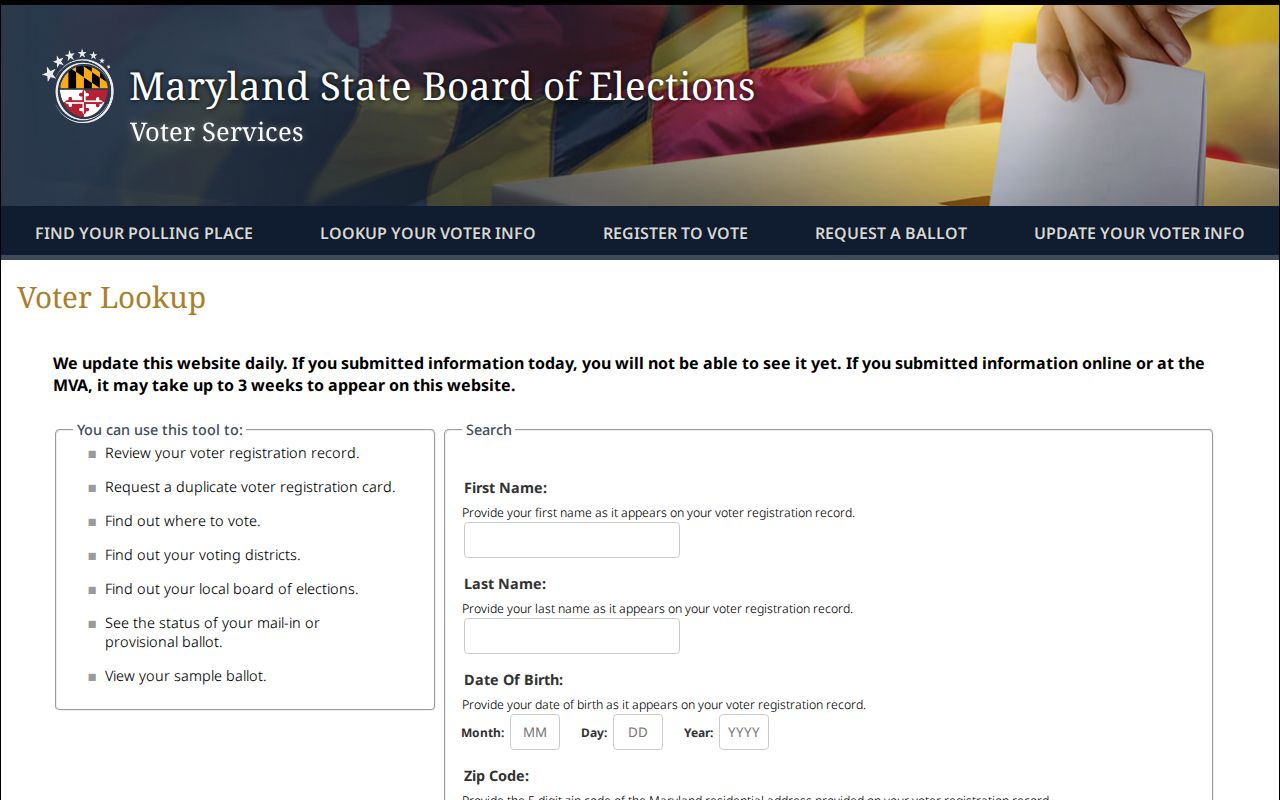
The multi-field design sets a real limit. A successful match helps confirm a registration record. It does not create a public directory of Potomac names, and it never reveals how anyone voted.
Potomac Case Search Matching
Maryland Judiciary Case Search offers statewide Circuit and District Court summaries. It includes the Montgomery County courts in Rockville. Users must accept the agreement and pass a human verification step. Name searches run exact by default. To broaden one, enter the first characters of a name followed by a percent sign. The percent sign cannot start a term or sit inside a word. Common names narrow well by first or middle name, court, case type, or filing-date range. A search returning more than 500 results displays only the first 500. It then asks for a tighter request.
A public result, weighed against other records, can help tell two people apart. It may list party names and roles, city or state, case number, court, filing and hearing dates, the charge or issue, docket labels, and a disposition summary. Some entries add a date of birth or an address. An address in a court summary is not a promise of a current address.
- Party name and role identify the person’s place in the case.
- Case number, court, and type locate the correct case series.
- Filing, hearing, and trial dates establish the record timeline.
- Charge, issue, docket label, and disposition describe the published summary.
- EstateSearch adds decedent, representative, attorney, alias, estate number, and docket history.
Maryland Judiciary Case Search is a lead index. Confidential categories stay excluded. Some historical or outcome details carry different online visibility. A legal conclusion belongs to the clerk's file, not a summary screen.
Potomac Court Record Detail
Potomac matters land in the Rockville courthouse complex. The Circuit Court and the District Court serving Montgomery County both sit there. A clerk is the fallback for a complete document. So is a courthouse public terminal for an archived file or a certified record. Juvenile, adoption, sealed or shielded matters stay out of a normal public search. Protected identifiers and anything covered by an order do too. Older criminal outcomes can also look different online even though the courthouse record remains public.
- Docket
- A docket is the court’s running list of filings, dates, and actions in one case. It is not automatically the full document file.
- Index and image
- An index points to a record with names, dates, and identifiers. An image is the scanned document itself, which may require the courthouse or another permitted access route.
- Certified copy
- A certified copy is issued by the custodian with its formal certification. Ask for it by case number, party name, document type, and filing date.
Federal matters live in PACER, a separate system from Maryland Case Search. PACER searches by party or case number. It charges by page under its stated schedule. Federal courthouse terminals offer another access route. Keep state and federal dockets separate when matching a Potomac name.
Verifying a Potomac Resident
Match at least two independent details before tying Potomac records to one person. A surname plus a town is thin evidence in a large county. A known address works better. A middle initial can help too. So can a former surname, a date, a deed role, or a probate connection. SDAT offers no owner-name query. A recorded deed, a parcel reference, or a legal filing may need to come first. A fitting voter confirmation may also help before the parcel card does. Case Search gives a lead, not identity proof or the full legal record.
- Write the person’s registered and former names, initials, suffixes, known date, and the Potomac address or parcel detail already supported by a record.
- Compare the name with a second independent field, such as a deed role, court date, estate representative, or eligible vital event.
- Narrow Case Search by court, type, or date and use the clerk file when the summary is not enough.
- Record which custodian supplied each fact, then ask that custodian to correct an error rather than merging uncertain results.
Potomac Vital Record Limits
Maryland vital records are not a resident lookup channel. Eligibility turns on the record type and the requester's relationship or direct and tangible interest. Archives guidance keeps birth records closed for 100 years. Death records stay restricted for 10 years. Older transferred indexes can still give a genealogy lead. Even so, a current certificate follows the custodian's own rules. The Division of Vital Records handles statewide products, while the Montgomery local health counter uses appointments for eligible birth and death services.
A sound match needs a name, event, and place. A deed, obituary, estate, or cemetery entry supplies them. Request the product only when eligible. For divorce, a DVR verification differs from the decree and pleadings held in the court file. Montgomery History abstracts and Maryland State Archives indexes can point toward an event. They cannot turn a restricted record into an open Potomac residents directory search.
Potomac Estate Lookup Trail
EstateSearch summarizes Maryland estates filed from 1998 to the present. Each entry can show the decedent, estate number and status, death and filing dates, personal representative, attorney, alias, and docket history. Those fields help separate two people with similar names. The Register of Wills holds the fuller probate file. Pair the estate with a will, obituary, deed transfer, or cemetery record first. Only then decide it belongs to the right Potomac resident.
- Write down the complete name, middle initial, former surname, suffix, and any known date or address.
- Check EstateSearch for an estate number, date pattern, representative, and alias that match the known person.
- Use the estate number to request or inspect the file through the Register of Wills when a fuller probate record is necessary.
- Compare the result with a deed role, obituary, cemetery record, or vital event before connecting relatives or property.
Older address trails often start with regional directories and newspapers at Montgomery History. Those holdings add a date or community reference. The Potomac city directory collections describe the same historical material. Still check any name against a closer record.
Potomac Reunion Record Route
Adoption reunion work is not an ordinary resident lookup. Maryland DHS Search, Contact and Reunion Services offers a lawful route with its own rules. MCVAR, the Maryland Contact and Reunion Voluntary Adoption Registry, serves eligible adult adoptees, birth parents, and other eligible parties. The Confidential Intermediary process serves them too. Mutual consent sits at the center of the whole reunion program. ASCARS services carry no state or local fee. A private agency's confidential-intermediary fee can still vary.
Use the program's own eligibility process instead of piecing records together. Do not try to rebuild a protected address from public record fragments. Adoption and original-birth records carry their own confidentiality rules. Court adoption records are sealed. Preserve the exact names, dates, and correspondence you already hold, since the authorized program may need that material.
Potomac Business Record Context
Maryland Business Express finds a legal entity by name or Department ID. A public profile may list the Department ID, legal name and status, principal office, resident agent and address, filing history, trade name, and document links. Filings after August 2001 are viewable without charge. That can confirm an affiliation recorded in the public entity file. It does not establish present residence or beneficial ownership.
A resident agent receives service of process. Maryland allows an adult, corporation, or LLC in that role. The agent is not necessarily an owner, officer, or occupant. Ownership is a separate question. For a named professional, Maryland's licensing search confirms a license, board, status, and any public disciplinary field. Compare entity data with the record's date and role. Verify a material conflict with the filing agency.
Potomac Resident Lookup Safeguards
Some absences are intentional. Maryland Safe at Home gives qualifying survivors and threatened people a substitute legal address and mail forwarding. Protected voters can have addresses withheld. Some court filers receive the same protection for contact details. A missing address proves no lack of Potomac ties. Motor-vehicle address data are separately restricted. They are also not an open public lookup source.
Take errors to the original custodian. SDAT handles assessment errors, the Board of Elections voter information, the originating court Case Search issues, the vital-record custodian event records, and the entity-record agency filings. For a listing outside an official record system, use the operator's current privacy or opt-out procedure. Keep the confirmation.
Lawful use. Use Potomac resident records for personal, lawful research and careful verification. Never assemble or use records to stalk, threaten, intimidate, or harass another person.